The Real Health Significance and Misconceptions of "Low-Tar" and "Light" Cigarettes
In the winter of 2018, I bought cigarettes at a convenience store near Chunxi Road in Chengdu. On the counter were rows of 8 mg, 10 mg, and 11 mg options, along with slim "light" cigarettes. The cashier casually said: "This one has lower tar, it's better." I nodded, as if I had purchased some half-price harm reduction solution. That evening I turned the pack over and read: tar 8 mg, nicotine 0.7 mg, carbon monoxide 9 mg — three numbers lined up neatly like a medical report. I genuinely felt: compared to my previous pack of 11 mg, I was inhaling at least 30% less "junk."
Only later did I slowly admit: that 30% was what the machine exhaled, not what my lungs accounted for.
The Numbers on the Pack Were Never a Bill for Your Lungs
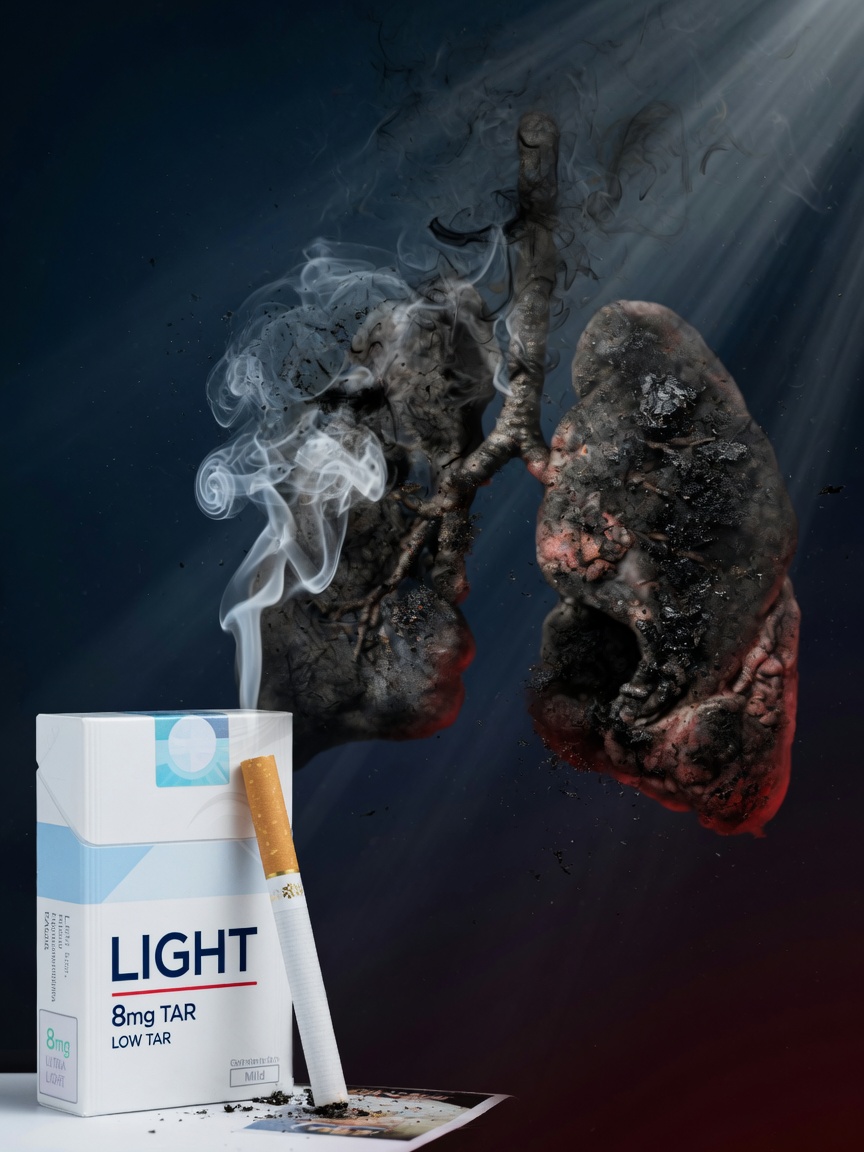
Terms like "low-tar," "light," "mild," and "ultra-light" automatically translate in a smoker's mind to "slightly less harmful." The Chongqing Center for Disease Control published a striking survey in its public education materials: among more than 1,400 cigarette buyers, nearly 70% tended to choose low-tar options; nearly 60% believed low-tar cigarettes were less harmful; over 40% thought they could reduce cancer risk; and about a quarter believed smoking low-tar helped with quitting. The numbers show that this misunderstanding is not about individual ignorance — the entire messaging system has been written into everyday shopping habits.
In 2013, the National Health and Family Planning Commission's core tobacco control messages stated firmly: "Low-tar cigarettes" and "herbal cigarettes" cannot reduce the harm caused by smoking; instead, they easily induce smoking and hinder quitting. Zhong Nanshan expressed a similar view at related report releases: among the smoking patients he treated, the proportion who smoked "low-tar" was extremely high — tar reduction did not reduce harm, but made people more comfortable smoking more.
My own turning point was more mundane. In the fall of 2020, at home I shone my phone light at an angle on the filter of a slim cigarette: a ring of nearly invisible tiny holes. Those were ventilation holes. When a smoking machine draws, air enters through these holes, diluting the mainstream smoke, making the machine-measured tar and nicotine look good. When a real person holds the cigarette, the index and middle fingers often press right on that ring; if the lips seal tightly, the holes are partially blocked. With the dilution cut in half, the "low" on the label starts creeping upward.
Philip Morris's internal research has long been cited: the tar and nicotine a smoker actually takes in can be several times higher than what smoking machines measure. The U.S. Federal Trade Commission later tightened its official endorsement of such testing methods — because the standardized machine smoking parameters of FTC/ISO are fundamentally different from how real people smoke through compensatory behavior. The milligrams on the package areare more like a uniform lab rating, not the real dose of your twenty puffs today.
Compensatory Smoking: Addiction Doesn't Recognize "Light"
Nicotine addiction tracks the concentration in your blood and brain, not the printing on the cigarette pack.
After switching to low-tar, many people develop the same set of unconscious behaviors: inhaling deeper; taking more puffs per cigarette; shortening the interval between puffs; holding the smoke in the mouth half a second longer; unconsciously opening two or three extra cigarettes a day. Some people also gently scrape the ventilation zone on the filter with their fingernails, or deliberately tilt the cigarette to let fewer holes "breathe." These are collectively known as compensatory smoking.
The fact sheets from the U.S. National Cancer Institute (NCI) and other agencies state bluntly: so-called light/low-tar cigarettes are not safer; smokers compensate by inhaling deeper, larger, and more frequent puffs, or by increasing the number of cigarettes, restoring nicotine intake — and bringing tar and other harmful substances back with it. The machine says "low," but after compensation, the exposure can match or even exceed that of medium-tar cigarettes.
I had a quantifiable period of self-observation. From March to June 2019, I switched from my usual labeled 11 mg cigarettes to 8 mg slim ones, believing I was "already cutting down." Over three months, my daily average rose from about 15 sticks to 18–20; the time per stick stretched from about 4 minutes to nearly 6 — not savoring, but chasing the hit. The morning first-cough didn't ease up; it got thicker. I blamed "dry weather" and "staying up late" at the time, but laterconsulting the smoking cessation pamphlets on the wall of the respiratory clinic, I realized: I had simply swapped the wrong formula of "sticks × labeled tar" for "deeper × longer × more sticks."
A widely cited observation from the University of Pittsburgh School of Medicine (involving more than 30,000 smokers, of whom over 12,000 switched to low-tar) found that those who switched to "light" cigarettes were about 46% less likely to quit compared to those who didn't switch. This matched what I saw around me — several colleagues at the office had the mantra "I smoke low-tar, it's no big deal," downloading and deleting quit-smoking apps repeatedly.
Compensation is not a moral issue; it is a pharmacological one. When the labeled tar goes down, nicotine is usually designed to go down with it. The addiction demand remains, and behavior automatically compensates. What it compensates for is not "health" — it is nicotine; andpackage along with it still comes the long list of harmful substances produced by combustion.
Why "Tar Reduction" Barely Moves the Needle on Real Harm Reduction
Tar itself is not even the complete proxy for harm. The scientific literature repeatedly emphasizes: tar is only a portion of the smoke condensate, and the strongly carcinogenic components within it (such as certain nitrosamines and polycyclic aromatic hydrocarbons) do not decrease proportionally with the labeled tar decline. Using tar milligrams as a "toxicity master switch" was the wrong yardstick from the start.
Worse is the market feedback loop: the "lighter" the pack, the easier it is for people hesitating to quit to find an excuse. Internal tobacco industry documents and multinational litigation materials show that one of the key functions of low-tar products is to divert people who "want to quit" onto the track of "just switch brands and keep smoking." The 2006 U.S. federal court ruling against several tobacco companies stated bluntly: falsely marketing "low-tar" as low-harm constituted deliberate deception; subsequent directives and bans moved toward stopping the use of terms like "light" and "low-tar" to create false reassurance.
Hong Kong's Department of Health stated publicly years ago: low-tar and low-nicotine labeling does not equal lower harm; smokers may inhale deeper, take more puffs, and consume more per day. The China CDC and local CDCs are highly consistent: there is no evidence that low-tar cigarettes are significantly safer than regular cigarettes; herbal cigarettes cannot be marketed as a harm reduction story either.
I have also seen a more insidious form of self-deception: biting the filter flat to lengthen the inhalation path, or specifically choosing "crush-ball light" cigarettes, believing that adding mint or fruit flavor makes it cleaner. Crush balls change the sensory curve, not the underlying chemistry of combustion. In the summer of 2021 in Chongqing, at 38°C (100°F), I lit a light slim cigarette and felt it had "no taste" by the middle, unconsciously lighting two in a row — this is not a weak-willed literary narrative; it is the compensation curve steepened by the heat.
Three Lies I Once Believed
Lie One: Lower Numbers = Lower Exposure.
Truth: The numbers are yields under a specific machine program, not individual exposure. Block the vents, change your mouth shape, and the ledger is rewritten.
Lie Two: Light = Gentle on the Lungs.
Truth: "Light" is a sensory and dilution design, not a toxicological proof of harm reduction. Outcomes like adenocarcinoma did not become "lighter" in parallel with the low-tar era as the public imagined; mechanism discussions consistently point to compensation and changes in inhalation patterns.
Lie Three: Smoking Low-Tar = A Stepping Stone to Quitting.
Truth: For a considerable portion of people, it is an illusion of a quitting substitute. You think you are "reducing harm," but you are merely repackaging the same nicotine homeostasis while delaying the cessation decision.
Of these three, the third is the most harmful. The first two are cognitive errors; the third directly rewrites behavior — the day you should quit becomes "let me keep smoking the low-tar ones for now."
Real Health Significance: Almost Nothing but "Label Comfort"
If I must give "low-tar/light" asober health significance assessment, my conclusion is narrow:
It has meaning in product engineering and compliance labeling — factories adjust ventilation, filter materials, and tobacco blend recipes according to testing methods to produce printable milligram numbers.
It has great significance in marketing and psychologicalcomfort — keeping anxious smokers buying and smoking.
In individual real-world harm reduction, the evidence does not support public expectations. There is no reliable basis to say: switch to low-tar, and your risks of lung cancer, COPD, and cardiovascular disease will decrease proportionally with the tar milligram reduction.
What truly changes the exposure curve is stopping or substantially reducing combustible tobacco use, not bouncing back and forth between 11 mg and 8 mg. Nicotine replacement therapy, prescription medications, and behavioral interventions discuss "how to leave combustion smoke behind"; low-tar discussions are about "how to keep burning, but look a bit more respectable." The two paths are not close relatives.
Someone might ask: aren't slim and medium cigarettes at least less hot on the lips and less smelly? Possibly. The "presence" in social settings changes, and the smell clinging to clothes is sometimes lighter. But that is odor and ritual, not medical harm reduction. Mistaking "less complaining from roommates" for "less damage to blood vessels" is another layer of confusion.
A Self-Check I Learned Only Later
If you are currently smoking labeled low-tar, try three days of simple record-keeping — more effective than any slogan:
- Count the sticks: Don't rely on feelings. Set a phone memo, log each cigarette you light. Many who switch from 11 mg to 8 mg silently increase their count within two weeks.
- Check inhalation depth: Notice whether "lung inhaling" becomes heavier, single-puff time lengthens, and butts becomenoticeably shorter. Compensation often starts here.
- Inspect the filter: After smoking, check if the ventilation zone is smeared with saliva or fingerprints; look for deliberate scraping marks.
- Examine your quittingmindset: After switching to light, do you feel more like quitting, or more like "no need to quit for now"? The latter means the label is making the decision for you.
I did a round before the 2022 Spring Festival: at that time I smoked an average of 12 "8 mg light" sticks a day, believing I was quite restrained. After seven days of recording, I found the actual count was 14–16 sticks, with an increased frequency of consecutive afternoon cigarettes. On the day I laid the numbers out, I blacked out the words "low-tar" on the pack with a pen — not as performance art, but refusing to be hypnotized by printed matter anymore.
At the End, My Judgment Is Only a Sentence and a Half
The real health significance of "low-tar" and "light" cigarettes is far smaller than the space they occupy in smokers' minds. They are more like a precision-engineered tranquilizer: using machine measurements, ventilation design, and advertising slogans, they collectively rewrite the truth about exposure. Once compensatory smoking kicks in, the labeled reduction is often swallowed up by behavioral increase; sometimes nothing is left, sometimes you owe more.
Don't replace quitting with switching to lights.
Don't give your lungs a fake excuse just because the pack prints a smaller milligram number.
If you are already smoking low-tar, this does not prove you "know better about health" — it only proves that, like me years ago, you were convinced by three lines of small print. Once you see through it, there is still only one effective direction: reduce and eventually stop inhaling burning tobacco smoke — the rest of the packaging narrative is mostly noise.
Key Data at a Glance
Source: Original article and published research
Tar Reduction vs Real Harm Reduction
Tar Reduction (Low-Tar/Light)
- Ventilation hole dilution
- Lower machine readings
- Compensation offsets cuts
- Keeps smokers comfortable
- Delays quit decision
Real Harm Reduction
- Stop or reduce combustible use
- Nicotine replacement therapy
- Prescription meds
- Behavioral intervention
- Escape combustion smoke
3-Day Self-Check
Log every cigarette
Heavier inhaling?
Vents blocked?
More or less motivated?